Industry
Business Process Outsourcing (BPO)
Hiring Type
High-volume customer support hiring
Assessment Scope
Language proficiency + functional readiness
Background
A large India-based BPO was hiring customer support executives for multiple international and domestic processes. Hiring volumes were high, timelines were tight, and candidate quality varied significantly across locations.
The hiring workflow relied on multiple disconnected tools:
- • A standardized third-party language test
- • Functional assessments managed manually
- • Interview-led screening for final decisions
This resulted in long screening cycles, operational dependency on recruiters, and inconsistent hiring benchmarks.

The Challenge

The client faced several operational challenges:
- • Language assessments were generic and not role-aligned
- • Functional capability was tested separately with no integrated scoring
- • Recruiters spent excessive time coordinating tests and interviews
- • Limited visibility into why candidates were being rejected or selected
- • High drop-offs due to lengthy assessment processes
The Ambition Hire Approach
Ambition Hire worked with the client to redesign their screening process using a role-based assessment framework.
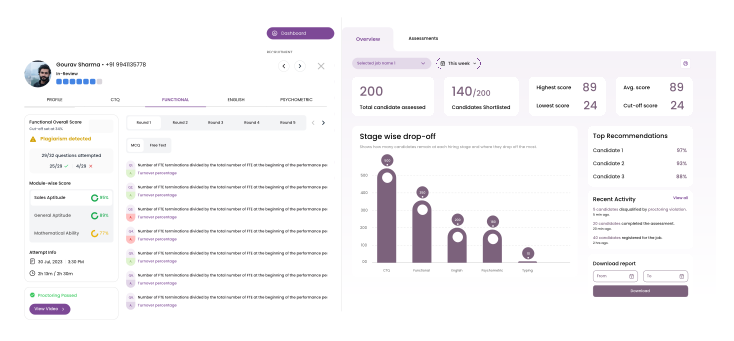
Key changes included
Customized language assessments aligned to the specific communication demands of customer support roles
Mixing and matching language modules instead of using a one-size-fits-all test
Functional assessments embedded into the same workflow
Scenario-based questions to test real customer interaction readiness
Proctored delivery to ensure assessment integrity
Unified reporting for recruiters and hiring managers
The Outcome
After implementation:

- • Screening turnaround time reduced significantly
- • Recruiter dependency on interviews reduced at early stages
- • More consistent shortlisting across locations
- • Improved visibility into candidate strengths and gaps.
- • Better alignment between assessment results and on-job expectations
The hiring team was able to scale volume hiring without increasing recruiter load.
Why This Worked
- • Assessments were designed around job reality, not generic benchmarks.

- • Assessments were designed around job reality, not generic benchmarks.
- • Language and functional skills were evaluated together, not in silos.
- • Hiring decisions were supported by structured data, not intuition.